Waste pressure
Brazil was estimated to generate 2.7 million tonnes of coconut husks in 2020; 74.5% came from green coconuts.
RIO DE JANEIRO ↔ BOIPEBA, BAHIA · CIRCULAR MATERIALS
building solutions with bio-based materials
Read the case01 — WHY TRANSFORM IT?
Green coconut husks are bulky, wet and slow to decompose. When discarded, they consume collection capacity and landfill volume; when processed, the same lignocellulosic structure becomes a durable, porous and moldable industrial feedstock.
Brazil was estimated to generate 2.7 million tonnes of coconut husks in 2020; 74.5% came from green coconuts.
High lignin content supports durability, while porosity supports drainage, thermal insulation and sound absorption.
The same feedstock can move from low-risk molded products to certified architectural components.
Collection, drying, molding, finishing and installation create work close to the source in both territories.
02 — HOW MUCH FEEDSTOCK?
Boipeba offers agricultural concentration; Rio offers a recurring urban waste stream.
70,000 trees × 30 fruits/tree/year ÷ 12
The lower case uses Embrapa’s 30 fruits/tree/year reference for low-input coastal systems; the managed case uses 130–150. Tree variety, productive age, irrigation and actual harvest rates in Boipeba must be audited before investment.
≈ 55,600 husks/month at Embrapa’s 0.9 kg average husk weight
Embrapa’s processing yields—15.1% raw fiber at 30% moisture plus 33.3% pith at 50% moisture—equal about 13.6 t/month dry equivalent from 50 t of wet husks. The range allows for contamination and process loss; a 30-day weighing test is still required.
The groves form a more controlled collection territory with shorter farm-to-plant distances and fewer counterparties. The penalty is island logistics: machinery arrives by water, finished goods must be dried and densified before crossing, and every shipment needs a Boipeba–Valença transfer before road freight to Salvador or the Southeast.
Rio is near architects, laboratories, retailers and the largest consumer markets in the Southeast. But access to discarded husks depends on beach concessions, municipal collection contracts and political continuity—an incalculable risk until a binding supply agreement and measured collection route exist.
03 — WHAT CAN IT BECOME?
Long fiber, short fiber and pith support different value chains. The examples below map the wider market; they are not all products in this project. The approved portfolio is fibre/substrate, one flat xaxim plate, acoustic panels and a new bioactive façade system.
| Material fraction | Products made today | Real example | Commercial maturity |
|---|---|---|---|
| Long fiber | Grow poles, ropes, mats, erosion-control netting | CoirGreen, Sri Lanka ↗ | Proven |
| Short fiber | Pots, xaxim substitutes, liners, molded parts | Eco & Ponto, Brazil ↗ | Proven |
| Fiber + binder | Acoustic, thermal and furniture-grade boards | NaturLoop Cocoboard®, Switzerland ↗ | Scaling |
| Pith / dust | Growing media, soil conditioner, hydroponic substrate | Amafibra, Brazil ↗ | Proven |
| Whole milled husk | Binderless boards and molded export pallets | CocoPallet, Netherlands ↗ | Scaling |
| Engineered composite | Bioreceptive façade and habitat panels | Respyre · analogous technology ↗ | Emerging |
04 — HOW LARGE ARE THE MARKETS?
Values below establish order of magnitude. Published estimates vary by research definition.
flowers and ornamental plants per year
≈ R$1.77 bn/monthIBRAFLOR / CEPEA figure ↗architectural acoustic panels per year
≈ US$725 m/monthMarket estimate ↗green walls per year
≈ US$233 m/monthMarket estimate ↗coco coir products per year
≈ US$34–57 m/monthIMARC estimate ↗Market-report figures are directional and use different category boundaries. The business case below uses bottom-up volumes and net selling prices instead.
05 — WHO ARE THE BENCHMARKS?
These companies provide market and technology benchmarks.
Pioneer xaxim substitute made from coconut fiber and natural latex; developed in 1996.
Price: quote requiredCompany profile ↗Coconut-fiber pots, substrates and grow products with national delivery.
Retail reference: R$31.90 / 20 cm potRetail listing ↗Retail line of natural coconut-fiber planters for ornamental plants.
Retail reference: from R$20.90Product line ↗Industrial coconut-fiber substrates with 18 formulations for multiple crops.
Price: quote requiredCompany ↗Cocoboard®: 90% coconut husk fiber and 10% bio-based tannin resin; 2440 × 1220 × 12 mm.
Price: project quoteTechnical product ↗Coir acoustic panels for offices, studios, hospitality, schools and auditoriums.
Price: project quoteProduct ↗Wood-free, ISPM 15-compliant export pallets molded from coconut-husk waste.
Price: trial + quoteBusiness model ↗Moss-supporting bioreceptive concrete coating and façade applications; technology benchmark, not coir.
Price: project quoteTechnology ↗Wood-wool acoustic panel used here as a price benchmark for a direct substitute.
Retail reference: €27/m²Retail listing ↗Prices observed in September 2026; taxes, freight, dimensions and wholesale discounts differ. Requote before procurement.
06 — WHAT FITS BRAZIL?
| Candidate | Demand evidence | Capital intensity | Differentiation | Decision |
|---|---|---|---|---|
| Prepared fibre, substrate + xaxim plate | High | Low | Medium | Launch first Early cash-flow products; the project does not plan to manufacture pots. |
| Interior acoustic panels | High | Medium | High | Scale second Strong architectural value; testing is essential. |
| Bioactive façade panels | Emerging | High | Very high | Develop as IP Use pilot façades before industrial launch. |
| Raw fiber / pith | High | Low | Low | Sell by-product Useful cash flow, weak defensibility. |
| Structural boards | High | Very high | Medium | R&D reference only No dedicated factory line in the six-year base case; contract pressing if required. |
07 — THREE-STAGE PRODUCTION ROUTE
Collection, sorting, defibering, washing, drying and classification are shared. Each stage adds tooling, testing and commercial complexity.
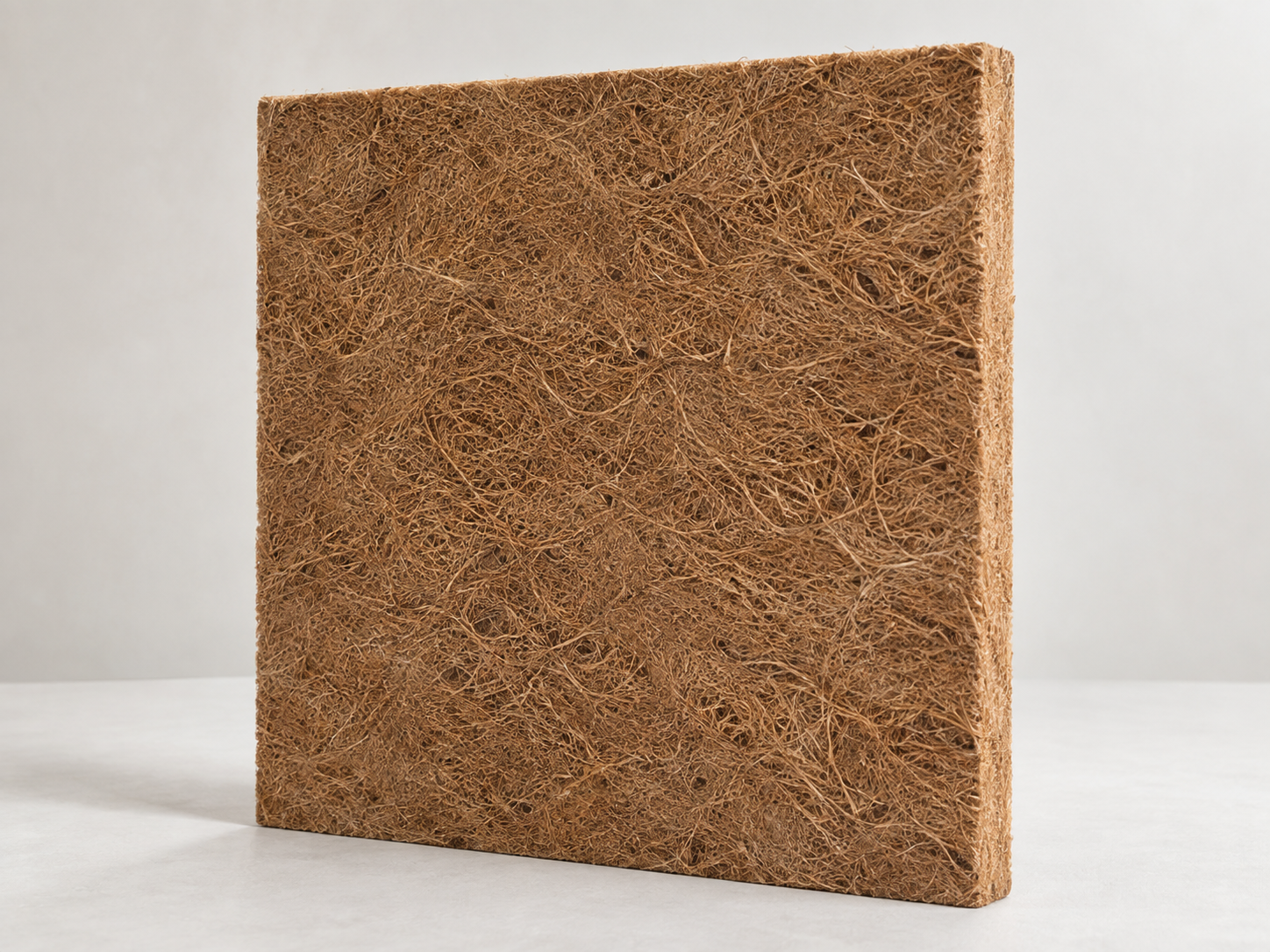
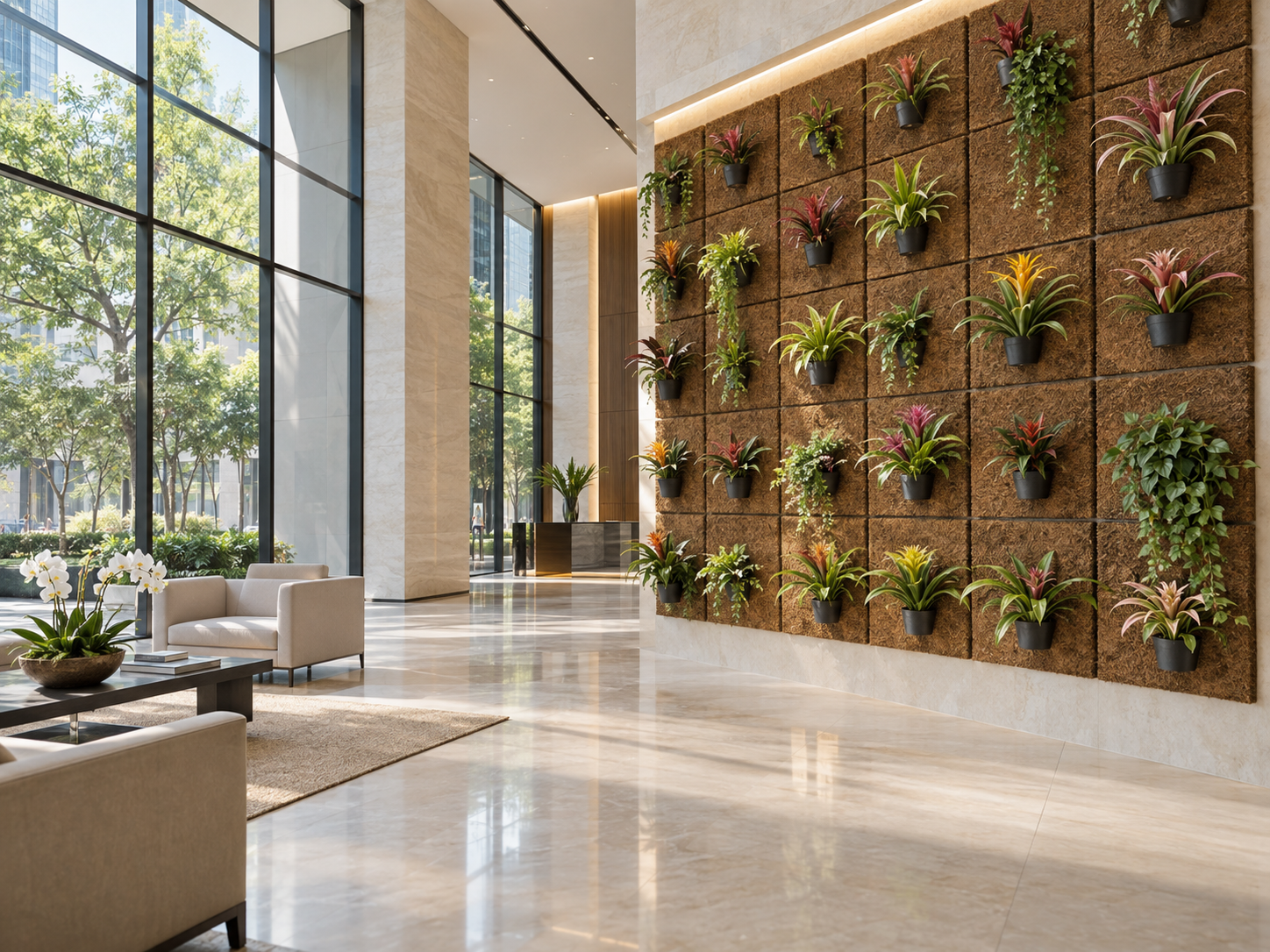
Prepared fibre and substrate plus one flat 50 × 50 cm xaxim-type plate—not pots or grow poles.
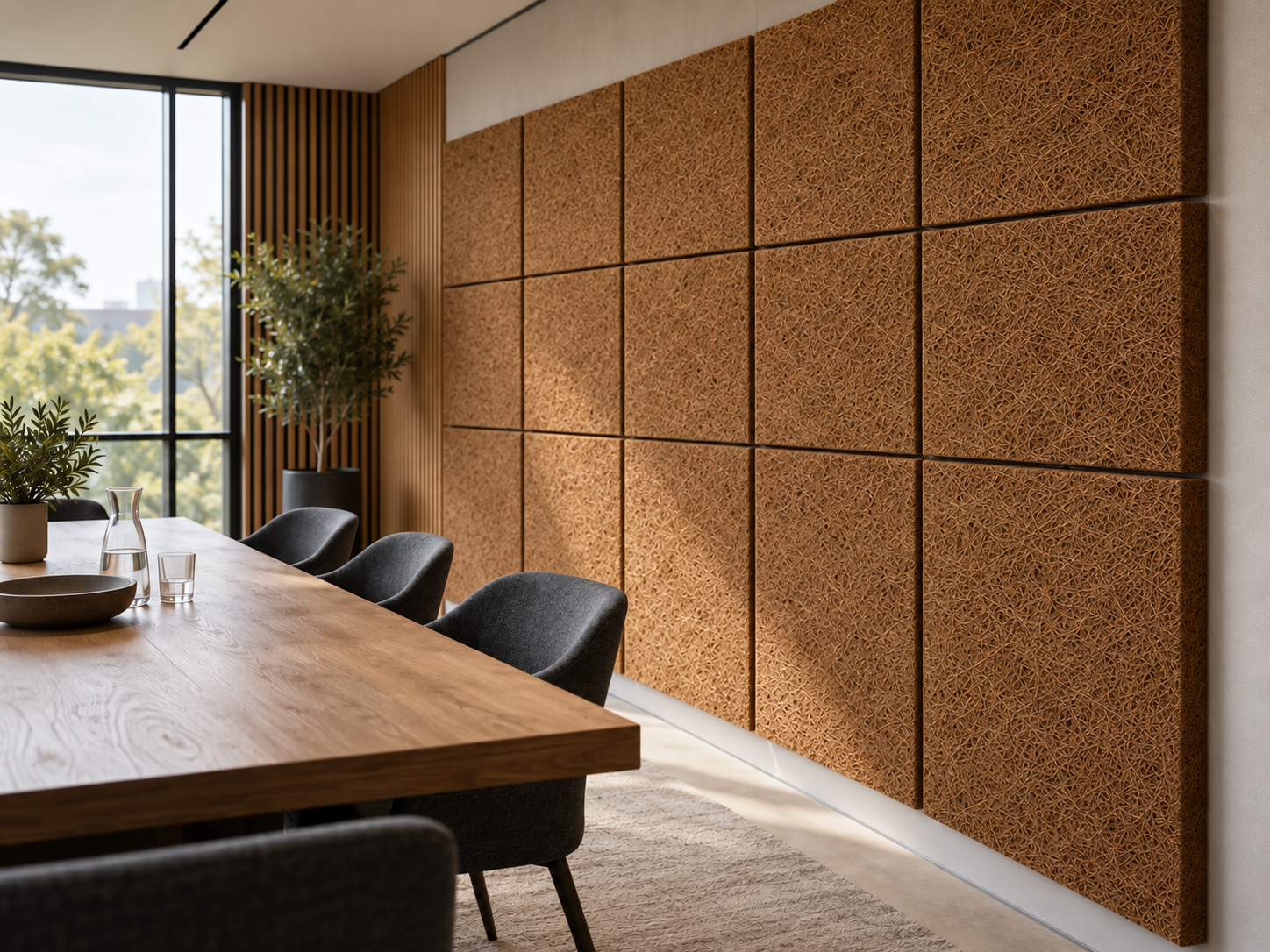
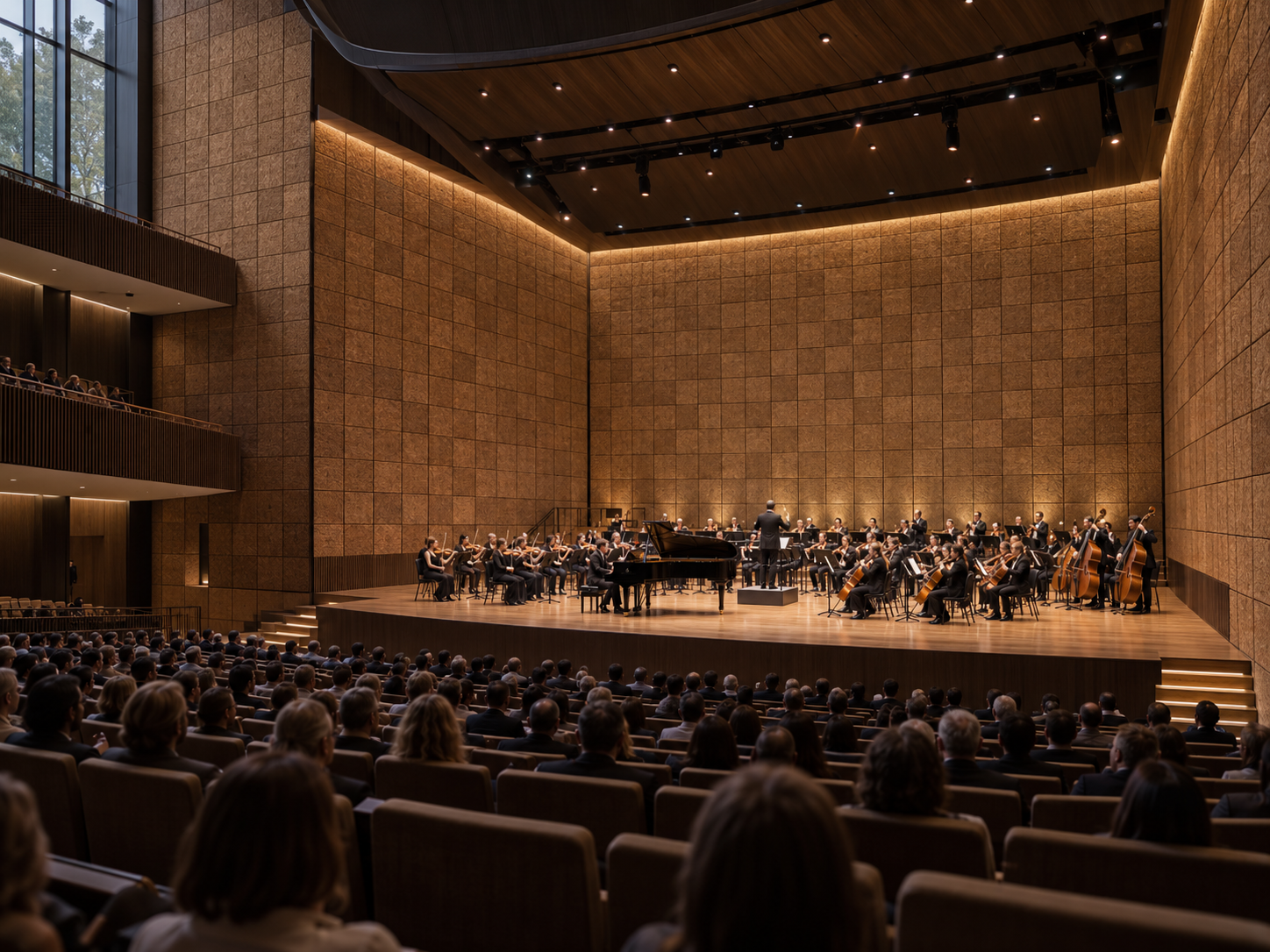
Commercial 50 × 50 cm wall and ceiling modules; bioactive R&D starts in parallel.
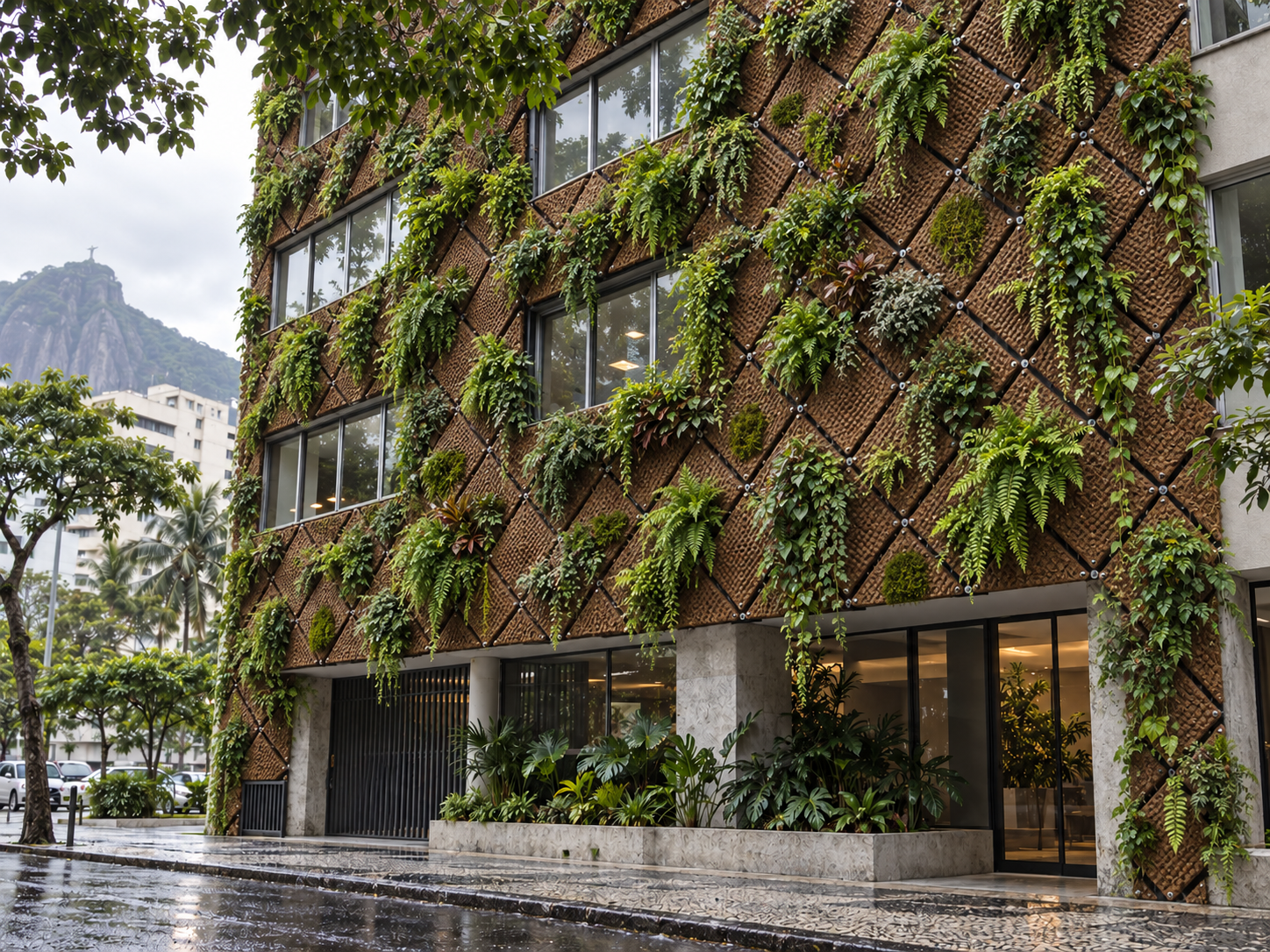
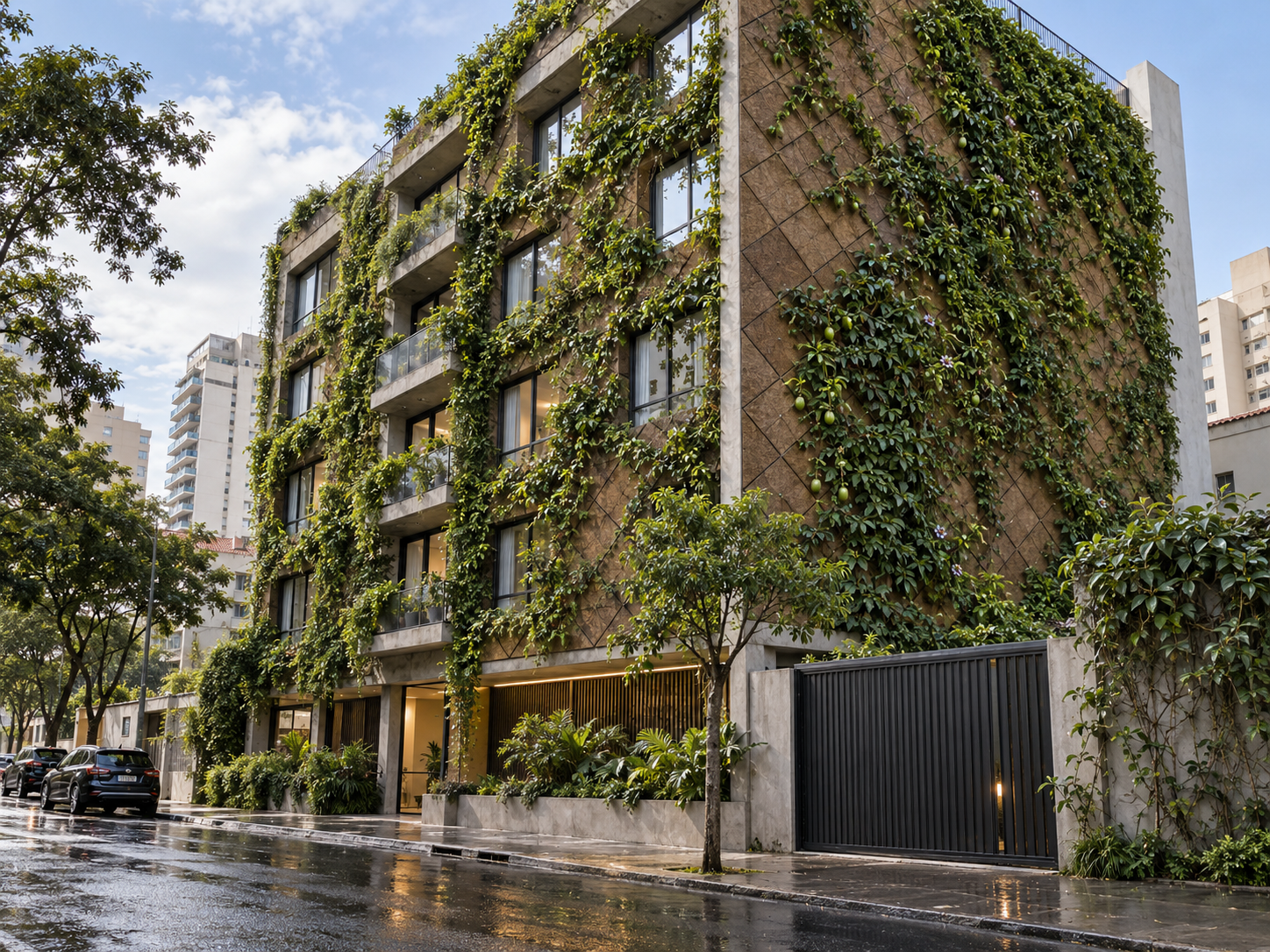
Pilots begin in year two, approval year three, domestic sales in year four and export pilots in year five.
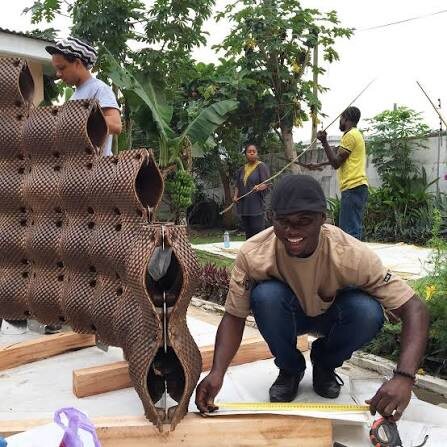
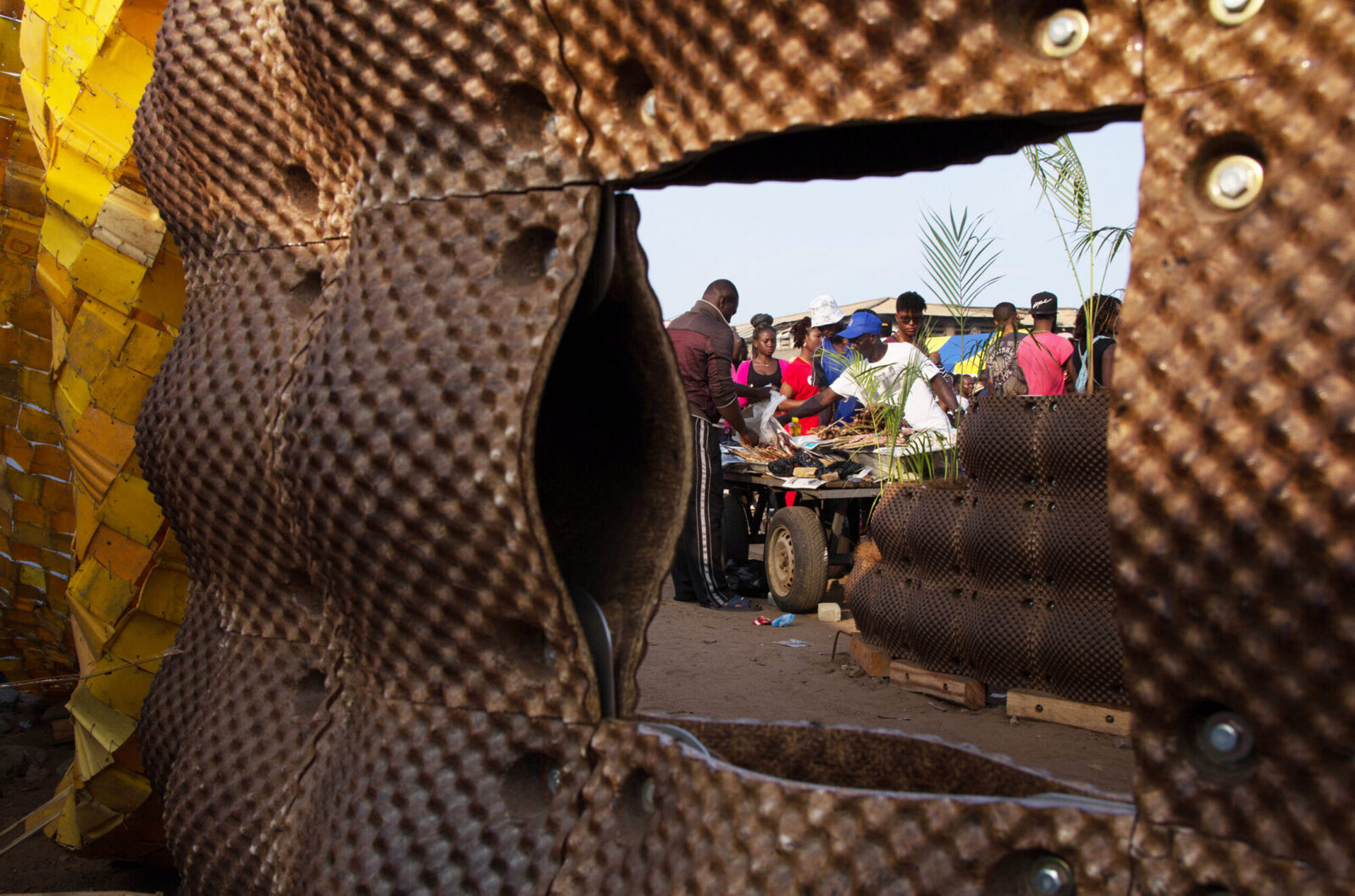
Mae-ling Lokko and the Ghana Studio used pressed coconut-husk fibers with soy binders on recycled burlap backing. The bolted modules demonstrate texture, curvature, rapid assembly and community-scale fabrication.
Relevance: a valuable construction and geometry reference, but not a bioreceptive façade. Phase 03 will be developed only from compressed coconut fiber: a denser structural core, progressively lighter outer layers and a final seed-bearing layer. It still requires exterior-durability, anchoring and biological-growth validation.
Rensselaer / CASE project source ↗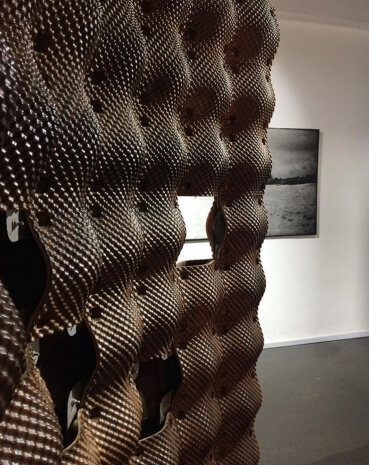
07A — CAN A COCONUT BOARD COMPETE WITH MDF?
A Cocoboard®-type board remains a technical reference and R&D platform for the bioactive system, not a product line in the six-year model. Any prototype pressing should be contracted until paid demand justifies a separate investment decision.
NaturLoop’s 2440 × 1220 × 12 mm Cocoboard® establishes a credible technical direction, but not a product in this commercial plan.
NaturLoop technical product ↗The density calculation is retained for laboratory learning only. It carries no production volume, revenue or dedicated machinery in the six-year base case.
Composite density research ↗Observed Brazilian market references explain why the project will not compete with commodity MDF. Research supports the bioactive system instead.
Brazil MDF reference ↗Use Cocoboard-type formulations only to learn about density, binders and durability for the bioactive system. Press prototypes through a laboratory or contract manufacturer; we allocated no dedicated board-factory CAPEX in the six-year model. Reconsider a standalone line only after verified performance, repeatable cost and contracted premium demand.
08 — WHAT INFRASTRUCTURE IS NECESSARY?
| System | Phase 01 · Fibre + plate | Phase 02 · Acoustic | Phase 03 · Bioactive |
|---|---|---|---|
| Core processing | Receiving slab, shredder/defiberer, washer, drainage press, solar or forced-air dryer and screens | Reuse Phase 01; add moisture control, calibrated fiber cutting and dust extraction | Reuse Phase 01–02; add density grading, multilayer mat forming, seed-layer preparation and closed-loop water treatment |
| Forming | Mixer, flat 50 × 50 cm plate mold and 20–50 t cold hydraulic press; heat is not essential when the selected binder cures at ambient temperature | Resin dosing, mat former and 30–50 t press. Heating is optional for a 24-hour castor-resin cure, but useful for faster thermosetting cycles | Contracted heated pressing for R&D, multilayer molds and anchoring jigs. Add a dedicated pilot press only after paid pilots validate the system |
| Finishing | Trim, drill, dry, label and pack | CNC/router, edge finishing, surface treatment and packaging | CNC, coating/biological inoculation area, curing racks, water-retention assembly |
| Quality + tests | Scale, moisture meter, dimensional and load checks | Acoustic absorption, VOC, fire reaction and dimensional stability | Weathering, heat cycling, fire, wind load, anchors, drainage and biological growth |
| Utilities + space | 250–400 m²; 3-phase power; water; drainage; covered drying | 600–1,000 m²; controlled press area; clean finishing room | 1,200–2,000 m²; lab zone; exterior mock-up yard; water recirculation |
A US$6.5–6.8k 50 t shop press is cold and has no controlled heated platens. A US-made Carver 48 t laboratory press with programmable heated platens is listed near US$35.3k before freight and import taxes. For a 50 × 50 cm panel, 50 t provides about 1.96 MPa. The asset-light plan therefore acquires only the press capacity needed for the acoustic cell and contracts heavier heated pressing during bioactive R&D; it does not buy a Cocoboard factory line.
Seed protection: seeds cannot pass through a high-temperature cycle. Structural density layers come first, then the seed-bearing surface is added by cold compression.
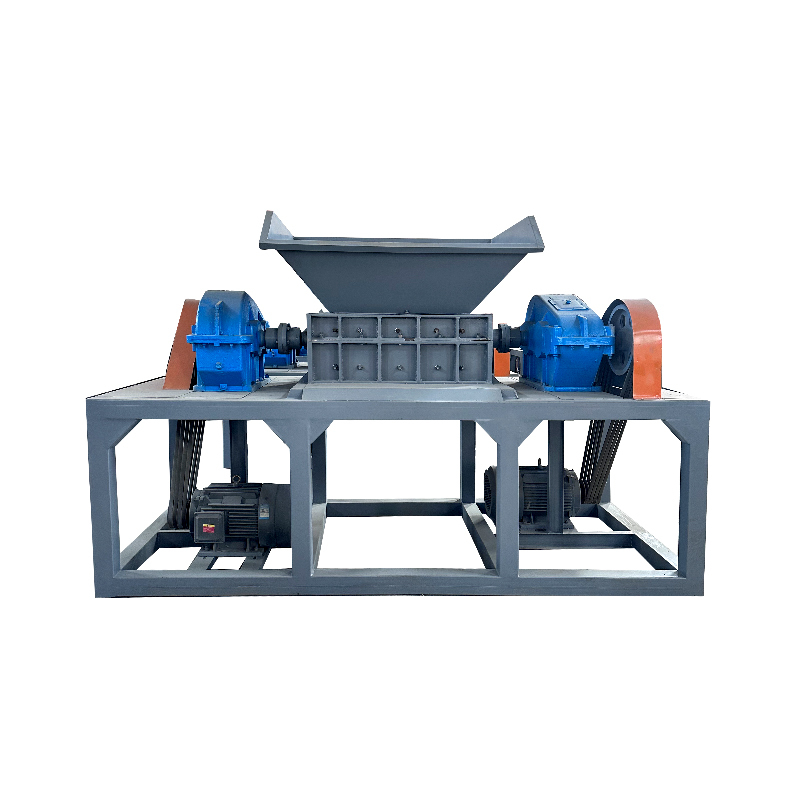
The shredder/defiberer, washer, drainage press, dryer and screens serve all three phases.
Representative machine source ↗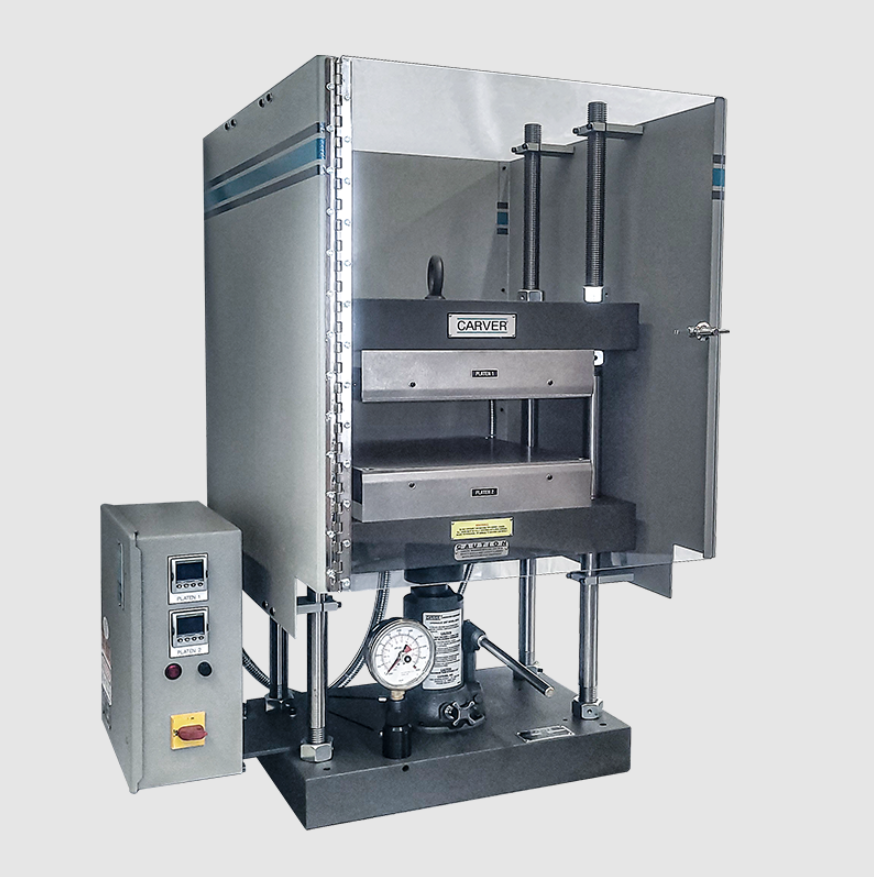
Low-density acoustic panels can cure cold in locked molds; heated platens shorten cycles when the tested bio-resin requires heat.
Carver press image and specification ↗
A laboratory or contract press forms the graded-density prototypes. A dedicated pilot line is gated by paid bioactive demand.
German press reference ↗KAKA shop press; useful for molds and cold pressing, without thermal platens.
Published listing ↗Carver automatic laboratory press with temperature control; small platen area, before logistics and import.
Published reseller price ↗Kraftmeister workshop press; not equivalent to a production hot press.
Published retail price ↗Hidrobrasil 600 × 600 mm and Wickert industrial heated presses are engineered systems; no public new-machine price was found.
German supplier listing ↗Brazilian 5 hp coconut shredder: R$7.3–7.7k ↗Defiberer: 100–150 kg/h, 20 hp, 3-phase ↗Binderless board hot-press research: 170–190°C ↗
09 — WHO WILL SELL IT?
Different products require different sales engines.
Garden centers, orchid growers, nurseries, landscapers, home centers, marketplaces, municipalities and reforestation programs.
Estimated serviceable marketR$10–32 m/year0.05–0.15% of Brazil’s R$21.23 bn flower and ornamental market.Architects, acoustic consultants, fit-out contractors, offices, schools, restaurants, hotels, cinemas, museums and cultural centers.
Estimated serviceable marketR$11–42 m/year30,000–100,000 m²/year × R$360–420/m² net product value.Developers, façade consultants, landscape architects, green-building projects, public infrastructure, universities and climate funds.
Estimated serviceable marketR$9–44 m/year5,000–20,000 m²/year × R$1,800–2,200/m² installed system value.Demand context: Brazil certified 125 LEED projects totaling more than 2 million m² in 2024. GBCI source ↗
10 — WHAT COULD THE RETURN BE?
Boipeba can make 193.8 t/year of dry fibre available from year two, but availability is a ceiling—not an automatic sales target. Commercial utilization rises from 40% to 100% over six years while the mix moves toward acoustic and bioactive systems.
The plan processes 46.5 t in year one, then 116.3, 135.6, 155.0, 174.4 and 193.8 t. The common 50 × 50 cm module stays; density, formulation, design and performance advance.
| Product | Commercial start | Dry fibre basis | Modeled price | Modeled unit cost | Role in year 6 | Decision |
|---|---|---|---|---|---|---|
| Prepared fibre / substrate | Year 1 | Per tonne | R$5,500/t | R$4,700/t | 5% of fibre | Cash-flow base Low CAPEX; volume follows contracts |
| 50 × 50 xaxim plate | Year 1 | 2.0 kg/unit | R$50/unit | R$17/unit | 5% of fibre | Simple entry SKU One flat 50 × 50 cm plate |
| Acoustic + bioactive systems | Years 2 / 4 | 9.6 / 8.0 kg/m² | R$360 / R$900–2,400 per m² | R$216 / R$600–1,550 per m² | 90% of fibre | Value engine Pilots and approval gate certification and scale |
Commercial utilization of available fibre: 40%, 60%, 70%, 80%, 90% and 100% from years one to six. Acoustic performance still requires laboratory validation. Acoustic density research ↗
revenue · 46.5 t processed
−R$0.32mEBITDA during commissioning
fibre-substrate / xaxim plate
40%commercial utilization
revenue · 116.3 t processed
R$0.61mpositive EBITDA
of fibre allocated to acoustic
R$750kgated acoustic-cell CAPEX
revenue · 193.8 t processed
R$8.48mEBITDA at scale
Brazil + export bioactive mix
R$4.71mcumulative free cash flow
These are the approved base-case outputs, not optimistic scenarios. Total staged CAPEX is R$3.375m. The model crosses cumulative break-even in year five; every capacity step remains conditional on contracted demand, technical evidence and cash availability.
10A — WHAT DOES THE DISCARDED-FIBER JOURNEY COST?
Two delivery routes are modeled: Rio beachfront collection → Ramos plant → Rio client, and Boipeba grove → island plant → Valença → Salvador. Wash, dry, transform and densify near the source before the longest journey.
The values in Item 10A were not obtained from supplier quotations. They are preliminary planning estimates built from: the fiber consumption of each product; allowances for washing, drying and processing; provisional production, packaging and labor costs; freight allocated to consolidated batches; and commercial or installation support calculated as a share of the modeled selling price. The totals are therefore hypotheses for comparing Rio and Boipeba—not verified operating costs. Before investment, each line must be replaced by measured production data and at least three supplier or logistics quotations.
One-way road distance used as a transparent shore-to-factory reference; the weighted collection route will vary by beach and stop sequence. Route reference ↗
Approximately 160 km for the combined water and road/ferry corridor. Actual cargo routing, transshipment and final delivery must be quoted. Boipeba–Valença ↗ Valença–Salvador reference ↗
Modeled wholesale price: R$50/unit.
Modeled net price: R$360/m².
Brazil price: R$900/m². Export begins as a year-five pilot at R$2,400/m² and R$1,550/m² modeled cost.
September 2026 pre-feasibility allowances, before indirect tax, financing and extraordinary island handling. Actual cargo-boat prices are not publicly standardized and require quotes. Road freight must respect ANTT minimum-freight rules; the current Rio–Salvador full-truck floor is roughly R$11.5k before tolls and ancillary charges. ANTT reference ↗
11 — HOW LONG IN EACH PLACE?
Each duration starts at that phase’s go/no-go decision and ends with a commercially saleable batch, required test evidence and a paid pilot or repeat order. The phases may overlap; these are critical-path durations, not cumulative project dates.
Rio: 1 month audit, 2–3 months site/equipment, 2 months commissioning and 1–3 months market pilot. Boipeba adds shed, 3-phase power and marine mobilization.
Laboratory queues, reformulation and heated-press commissioning drive the range. Boipeba requires imported equipment and critical spares on the island.
At least 12 months of exterior exposure is retained inside a 24–36 month Rio program; Boipeba adds logistics and slower specialist access.
12 — HOW MUCH INVESTMENT?
Ranges include equipment, facilities, development, initial testing and working capital. Rent and launch payroll sit inside the working-capital lines; ongoing rent and employee compensation are operating expenses reflected in EBITDA. Land acquisition and financing costs remain excluded.
Gate: stable fibre, substrate and 50 × 50 plate batches with repeat orders.
Gate: tested panel, specification partners and paid pipeline before expansion.
No Cocoboard factory: heavy pressing remains outsourced until commercial evidence supports ownership.
Four-person launch team at 40% commercial utilization.
Seven-person team, acoustic production and first bioactive pilots.
Nine to fifteen people as approval, domestic sales and export advance.
The model buys a manual/cold press in year one and an acoustic cell in year two. Bioactive and Cocoboard-type R&D uses contracted heated pressing first; ownership is considered only after paid pilots.
The case uses 40%, 60%, 70%, 80%, 90% and 100% of the fibre available in each year. EBITDA turns positive in year two and net profit remains positive thereafter. The R$3.375m programme reaches cumulative break-even in year five.
| Indicator | Year 1 | Year 2 | Year 3 | Year 4 | Year 5 | Year 6 |
|---|---|---|---|---|---|---|
| Commercial utilization | 40% | 60% | 70% | 80% | 90% | 100% |
| Dry fibre processed | 46.5 t | 116.3 t | 135.6 t | 155.0 t | 174.4 t | 193.8 t |
| Revenue | R$0.53m | R$3.62m | R$5.84m | R$8.88m | R$17.23m | R$30.67m |
| Net profit | −R$0.37m | R$0.30m | R$0.45m | R$0.78m | R$2.43m | R$5.29m |
| Net margin | −70.3% | 8.2% | 7.8% | 8.7% | 14.1% | 17.3% |
Cumulative free cash flow is approximately +R$0.33m at the end of year five and +R$4.71m at the end of year six. The model therefore reaches payback during year five without a Cocoboard line or launch solar purchase.
Embrapa productivity ↗Embrapa processing yields ↗Brazil minimum wage ↗SiNAT / DATec ↗EU Access2Markets ↗
Editable Excel model with demand-led utilization, product mix, operating expenses, progressive payroll, staged CAPEX, free cash flow, checks and source notes.
13 — SCIENTIFIC LIBRARY
Scientific papers and technical references gathered during product development. Links lead to the publisher, DOI or scientific repository.
Living bibliography · 25 references collected
14 — IMMEDIATE NEXT STEP
A focused technical-research stage will replace assumptions with quotes, samples and operating data.
Field audit in Rio and Boipeba, benchmark and laboratory visits, conversations and interviews with researchers, supplier visits and quotations.
Travel, technical visits, sampling, preliminary tests, specialist hours and documented equipment quotations.
Field-research report, real machinery budget, measured logistics routes and a revised business plan with go/no-go gates.
Embrapa Agroindústria Tropical · Amafibra / Sococo · Coquim and Brazilian molded-coir producers · acoustic and fire laboratories · Wageningen Labs - façade and bioreceptivity research groups · NaturLoop technical exchange if access is granted.

Rua Viúva Lacerda, 131 · Humaitá
Rio de Janeiro — RJ · Brazil